 comparison
Alternatives to RPO for Startups: 5 Practical Options
Table of Contents
- Why Startups Look Beyond Recruitment Process Outsourcing
- Quick Comparison: RPO Alternatives at a Glance
- In-House Recruitment vs Agency: Building Your Own Hiring Engine
- Recruitment Agency Pricing Models UK: What Startups Actually Pay
- Fractional Talent Acquisition Services: Senior Expertise Without the Full-Time Cost
- Dover: A Hybrid Software and Recruiter Model
- Man Power Contractors UK LTD: Specialist Manpower for Industrial and Technical Roles
- How to Choose the Right Alternative to RPO for Your Startup
- Frequently Asked Questions
Last Updated: September 16, 2026
Why Startups Look Beyond Recruitment Process Outsourcing
Recruitment process outsourcing hands your entire hiring function to an external provider on a long-term contract. For a startup, that model often costs more than it returns. At Man Power Contractors UK LTD, we speak to founders every week who signed an RPO deal early, then found the contract locked them into fees and timelines that never matched their hiring pace.

Quick Comparison: RPO Alternatives at a Glance
Here is how the five practical alternatives to recruitment process outsourcing for startups compare on cost structure, speed and control.
| Alternative | Payment Model | Best For | Main Trade-Off |
|---|---|---|---|
| In-house recruitment with an ATS | Software subscription | Teams hiring regularly | Needs internal time |
| Contingency agency | Fee on successful hire | One-off critical roles | Costs rise with volume |
| Fractional talent acquisition | Hourly or project fee | Specialist short-term needs | Onboarding time |
| Hybrid software plus recruiter | Subscription and usage | Scaling tech teams | Needs oversight |
| Specialist manpower agency | Contract or project rate | Industrial and technical roles | Sector-specific scope |
In-House Recruitment vs Agency: Building Your Own Hiring Engine
In-house recruitment means your own team owns candidate sourcing, assessment and offer management, supported by an applicant tracking system rather than an external provider. It suits startups that hire often enough to justify the software and staff time, and it is the only model where you keep full ownership of your candidate data and employer brand from day one.
What In-House Hiring Actually Requires
Before you commit, be honest about the following:
- A named owner. Someone, founder, ops lead or office manager, has to own the pipeline. A tool without an owner is a subscription you cancel in month three.
- A written process. Advert, screen, structured interview, scorecard, offer. Without structure, in-house hiring drifts into unstructured chats and bias.
- An ATS that fits a small team. Enterprise systems are over-specified at startup scale.
- Compliance basics. Right to work checks, data retention rules and equal-opportunity record-keeping apply from your first hire, not your fiftieth.
Equity-Based Hiring: The Startup-Specific Lever
One thing enterprise-focused RPO guides never cover is equity. Early-stage teams often compete for senior talent on a package that is part salary and part share options, which changes the recruitment conversation entirely. A candidate weighing an offer against a larger employer is pricing risk, not just comparing base pay. In-house hiring lets you shape that conversation directly, adjust vesting and cliff terms, and explain the story behind the equity, something an outsourced recruiter on a fixed brief rarely has the mandate or context to do well.
Manatal: Internal ATS for Cash-Conscious Startups
Manatal is an AI-powered applicant tracking system built for internal teams that want professional-grade hiring tools without outsourcing. Its candidate matching and scoring, social media enrichment and job board integrations cover most of what a small team needs, from £12 per user per month.
Integration With Your Existing ATS
If you already run Greenhouse, Lever or Ashby, the practical question is not 'which ATS should we buy' but 'what will plug into what we have'. Most startup-friendly ATS platforms expose an open API and integrations marketplace, so a fractional recruiter, contingency agency or sourcing tool can usually be layered on top rather than replacing your system of record. Before engaging any external provider, ask three questions:
- Can you work inside our existing ATS rather than exporting candidates to your own?
- Who owns the candidate record if we part ways?
- How do you handle data retention and deletion requests under UK data protection rules?
Information Commissioner's Office guidance on recruitment and data protection
Recruitment Agency Pricing Models UK: What Startups Actually Pay
Recruitment agency pricing models in the UK generally fall into three structures: contingency, retained and fixed-fee. Contingency means you pay only on placement; retained means staged payments, usually a portion upfront; fixed-fee sets a single price per role regardless of salary.
Recruiting from Scratch: Contingency Hiring for Early-Stage Teams
Recruiting from Scratch runs a contingency model aimed at early-stage companies, with a reported average time-to-hire of around 29 days. You pay on a successful hire, keeping upfront risk low.
Fractional Talent Acquisition Services: Senior Expertise Without the Full-Time Cost
Fractional talent acquisition services give you an experienced recruiter for a set number of hours or a defined project, rather than a permanent salary or long RPO contract. You get senior judgement on recruitment strategy, employer branding and talent pipeline without committing to a full-time hire.
DIY vs RPO vs Fractional: A Decision Framework
Most guides compare RPO against agencies and stop there. The more useful comparison is three-way: doing it yourself, hiring a fractional recruiter, or signing an RPO contract. Each shifts risk differently.
| Model | Who owns the process | Cash commitment | Best fit |
|---|---|---|---|
| DIY in-house | You | Software subscription plus your time | Regular, predictable hiring |
| Fractional recruiter | Shared, they advise, you decide | Hourly or project fee | Intermittent or specialist hiring |
| RPO | The provider | Long-term contract, often volume-based | High, sustained hiring volume |
The Risks of Outsourcing Culture-Building Too Early
There is a startup-specific risk enterprise RPO content never mentions: your first twenty hires define your culture, and handing that process to an external provider too early can dilute it. A recruiter working to a brief optimises for the brief, skills, experience, availability, not the intangible fit that makes an early team cohere.
1840 & Company: Flexible Fractional Recruitment Support
1840 & Company offers fractional recruitment and staffing as a flexible alternative to full-scale RPO, including global talent pools, managed services for specific projects, and compliance and payroll support.
Dover: A Hybrid Software and Recruiter Model
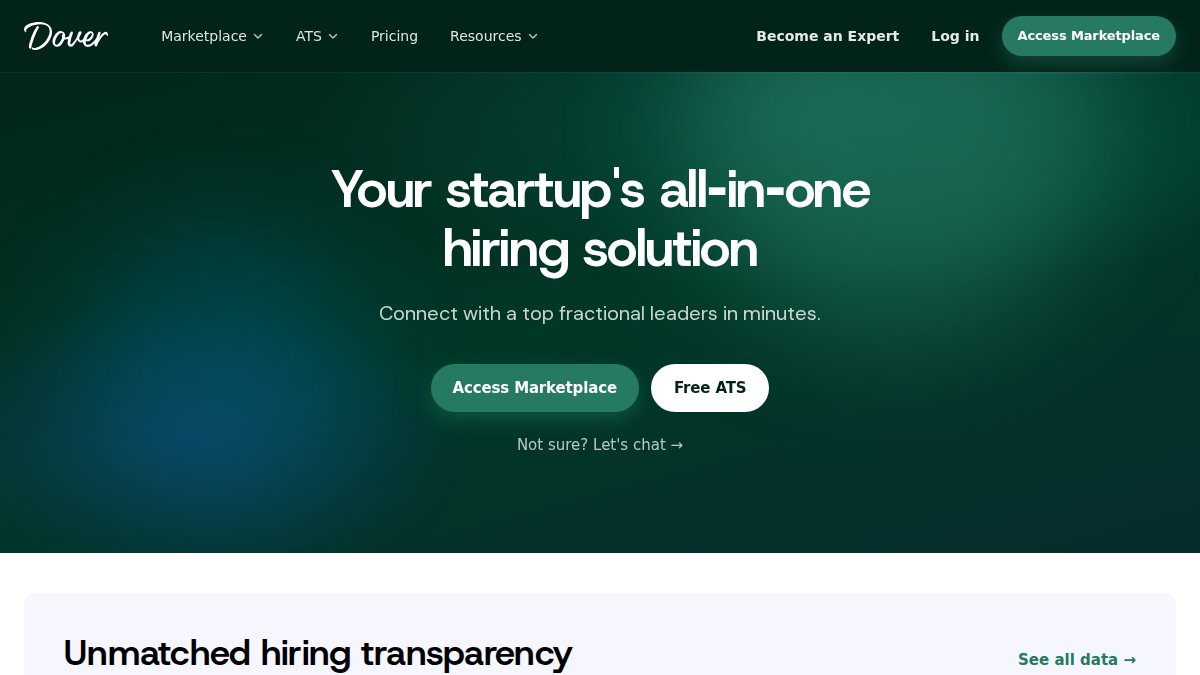
Dover combines automated recruiting software with on-demand human recruiters, covering sourcing, outreach, ATS functionality and pipeline reporting in one platform. It suits startups that want automation handling admin while real recruiters work the shortlist.
Man Power Contractors UK LTD: Specialist Manpower for Industrial and Technical Roles
Man Power Contractors UK LTD is a recruitment agency providing skilled manpower solutions across a diverse range of industries, connecting businesses with top-tier talent and meeting workforce needs with precision and reliability. For startups in construction, logistics, manufacturing, hospitality or social care, this is often the most practical route: vetted, sector-specific people without building a recruitment function from zero.
How to Choose the Right Alternative to RPO for Your Startup
Choosing the right alternative comes down to three questions: how often you hire, how specialised the roles are, and how much internal time you can commit. Answer honestly and the decision usually makes itself.
Use this checklist to work through it:
- Estimate your hires for the next 12 months. Fewer than five points to contingency or specialist agency support.
- List the roles that need specialist skill sets. Industrial, technical and care roles favour a specialist provider.
- Count the internal hours available each week for screening and scheduling.
- Check whether your existing ATS can integrate with any external provider you are considering.
- Confirm the provider's compliance and vetting process in writing before you engage.
- Set a review date 90 days in to assess cost-per-hire and time-to-hire against your baseline.
Risk Assessment for Early-Stage Companies
Risk assessment for early-stage companies should focus on three exposures: financial, compliance and continuity. Financial risk means committing to fees before you know your hiring volume. Compliance risk means a contractor arriving without the right documentation. Continuity risk means depending on a single provider that cannot scale when you need it most.
ACAS guidance on hiring and employment contracts
Frequently Asked Questions
What are the main drawbacks of RPO for early-stage startups?
RPO providers typically require long-term contracts, minimum hiring volumes, and set management fees that assume predictable recruitment needs. For startups with fluctuating, low-volume hiring, this means paying for capacity you may not use. Setup also takes time, and you lose direct control over employer branding. Many early-stage companies find contingency agencies, fractional recruiters, or internal hiring with an ATS offer better value and flexibility.
How does a recruitment agency differ from an RPO provider?
An RPO provider takes over part or all of your recruitment function on a long-term, often retainer-based contract, managing processes, technology, and sometimes your employer brand. A recruitment agency works on individual vacancies, usually on a contingency or retained basis, and you pay when a placement is made. Agencies are transactional and easier to switch; RPO is a strategic partnership with deeper integration and higher commitment.
Should startups use in-house recruitment or external partners?
It depends on hiring volume and budget. If you hire one to three people a year, an external agency or fractional recruiter is usually cheaper and faster. If you plan to hire six or more roles annually, an internal recruiter or founder-led hiring supported by an ATS such as Manatal (from around £12 per user per month) can reduce cost-per-hire and keep candidate data in-house. Many startups blend both, using agencies for specialist roles while building an internal talent pipeline.
What is the most cost-effective way to scale a startup team in the UK?
There is no single answer, but contingency-based agencies and fractional talent acquisition services often offer the lowest upfront risk. You pay only when a hire succeeds, or for a set number of hours per month. Combining a low-cost ATS for pipeline management with a specialist agency for hard-to-fill roles keeps costs predictable. Always ask for a clear breakdown of recruitment agency pricing models UK, including any rebate periods and replacement guarantees.
How do I integrate an alternative hiring model with our existing ATS?
Most modern ATS platforms, including Manatal and Dover, support integrations with job boards, LinkedIn, and email. When working with an agency or fractional recruiter, agree on a shared pipeline process: ask them to submit candidates through your ATS or a shared spreadsheet with consistent fields. This keeps candidate data in one place, avoids duplicate outreach, and gives you accurate time-to-hire and cost-per-hire metrics. Set up a simple service-level agreement covering response times and submission quality.
Hiring your first ten people without a full RPO contract is entirely achievable, but it demands a provider who understands fluctuating demand and sector-specific compliance. Man Power Contractors UK LTD specialises in skilled manpower solutions across industrial, technical, care and hospitality roles, with a focus on meeting workforce needs precisely and reliably. Get started with Man Power Contractors UK LTD and build a hiring pipeline that scales with your startup rather than against it.