 how-to
How to Prepare for Offshore Oil Rig Interviews
Table of Contents
- What the Hiring Manager Actually Wants to See
- Offshore Oil Rig Interview Questions and Answers
- BOSIET Training Requirements and Survival Certifications
- How to Build an Industry-Focused CV for Offshore Roles
- Working with Offshore Recruitment Agencies
- Mock Interview Scenarios and What to Expect
- The Reality of Offshore Work Life and Shift Rotations
- Conclusion
- Frequently Asked Questions
Last Updated: September 22, 2026
What the Hiring Manager Actually Wants to See
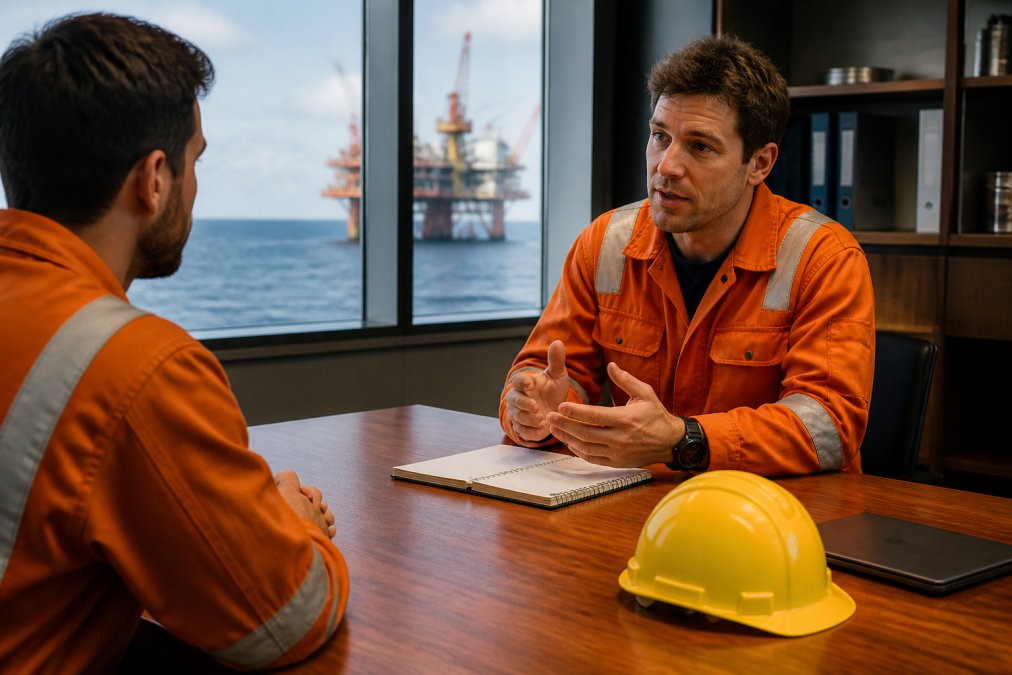
Offshore drilling interviews test whether you can stay calm, follow safety rules and work well in a small team for weeks at a time. Technical skill matters, but hiring managers on rigs hire for reliability first. This guide from Man Power Contractors UK LTD walks you through how to prepare for offshore oil rig interviews, from certificates to mock questions.
Most candidates obsess over the wrong things. They memorise equipment specs but freeze when asked about a near-miss. The hiring manager already knows you can swing a wrench. What they cannot see from your CV is whether you will raise a hand when something looks wrong at 3am.
So the interview is really a safety and character check. Below, we'll show you exactly how to prepare for offshore oil rig interviews, step by step.

Safety First: Your BOSIET and Medical Checks
You cannot start an interview conversation without the paperwork. Employers want proof you can survive the journey before you discuss the job.
- BOSIET covers sea survival, fire fighting, first aid and helicopter escape (Essential Offshore Safety Training: BOSIET and HUET).
- HUET is the helicopter underwater escape module within that training.
- An offshore medical certificate confirms you are fit for the rig environment.
- Personal protective equipment (PPE) knowledge shows you understand site rules.
A common mistake is turning up without these. It tells the recruiter you have not done basic research.
Offshore Oil Rig Interview Questions and Answers
Expect two question types: technical and behavioural. The first checks what you know about the rig floor, the second checks how you behave when something goes wrong. Most candidates prepare only for the first and lose the interview on the second.
Prepare short, honest answers using real examples from your onshore experience.
Technical Questions About Rig Floor Operations
Technical questions are not a quiz on equipment manuals. They test whether you understand the sequence of a job, the risks at each step, and when to stop. A common pattern is a three-part question: describe the task, describe the hazard, describe the control.
Typical prompts include:
- "Walk me through a job you completed on a rig floor or a similar industrial site."
- "How do you carry out a pre-use inspection on lifting equipment?"
- "What would you do if you found a hydraulic leak during a routine check?"
- "Explain the difference between a near-miss and an incident, and give an example of each."
A Rig Terminology Cheat Sheet
You do not need to be a driller to sound credible, but you do need to recognise the vocabulary. Learn these before the interview and be ready to explain any one of them in a sentence:
| Term | Plain-English meaning |
|---|---|
| Derrick | The tall steel tower that supports the drilling string |
| Rotary table | The rotating platform that turns the drill string |
| Mud (drilling fluid) | Fluid circulated down the hole to cool the bit and carry cuttings up |
| Roughneck | A rig-floor crew member who handles pipe |
| Roustabout | A general labourer on the rig, often entry-level |
| Toolpusher | The senior rig-floor supervisor |
| Tour / rotation | A shift, or the on/off cycle (for example, three weeks on, three off) |
| Muster | The roll-call and assembly point during an emergency drill |
| Permit to work | The formal authorisation before a high-risk task begins |
| Stop-work authority | The right of any worker to halt a job they believe is unsafe |
Behavioural Questions on Teamwork and Hazard Awareness
Behavioural questions dig into how you act under pressure. Use the STAR method, situation, task, action, result, and keep each answer to roughly 60 to 90 seconds. Here are two worked examples you can adapt to your own experience.
-
Situation: During a night shift on an onshore site, I noticed oil pooling under a hydraulic unit.
-
Task: I needed to stop the leak spreading and make the area safe without halting unrelated work.
-
Action: I isolated the unit, placed spill mats, informed my supervisor and logged it in the handover book.
-
Result: The fault was fixed before the next shift, and the log entry became the evidence for a planned maintenance change.
-
Situation: A colleague skipped a pre-use check because we were behind schedule.
-
Task: I had to raise the issue without turning it into a personal argument.
-
Action: I asked him privately to walk the check with me, and we found a frayed sling.
-
Result: We replaced the sling, finished the job safely and agreed to run checks together in future.
BOSIET Training Requirements and Survival Certifications
BOSIET training requirements are set by the offshore industry and refreshed every few years, so always check the current rules with your training provider before booking. The course runs over several days and mixes classroom work with pool drills.
How to Build an Industry-Focused CV for Offshore Roles
An industry-focused CV leads with certifications, not job titles. Put your BOSIET, medical and any survival training at the top where a recruiter will see them in seconds.
Keep it to two pages. Recruiters scan fast.
| CV Section | What to Include | Why It Matters |
|---|---|---|
| Certifications | BOSIET, HUET, offshore medical | Proves you can start work |
| Onshore experience | Roles, dates, key tasks | Shows relevant background |
| Transferable skills | Teamwork, shift work, safety | Links your past to rig life |
| References | Supervisors who saw you work | Builds trust fast |
Working with Offshore Recruitment Agencies
Offshore recruitment agencies do the screening so employers do not have to. A good agency knows which certificates are current and which roles suit your background.
Mock Interview Scenarios and What to Expect
Mock interviews build confidence and expose the gaps you did not know you had. The mistake most candidates make is rehearsing answers in their head. Offshore interviews are spoken, timed and often panel-based, so practise out loud, ideally with someone who will interrupt you.
Run Three Full Mock Scenarios
Set a timer. Aim for 60 to 90 seconds per answer. Record yourself on your phone and listen back for filler words, vague claims and answers that never reach a result.
The Psychological Resilience Angle
Most guides stop at physical fitness. The harder test offshore is mental: isolation, disrupted sleep, confined quarters and weeks without your normal support network. Employers increasingly ask about it directly because a crew member who struggles quietly is a safety risk.
Prepare honest answers to these:
- How do you switch off after a hard shift when you cannot leave the site?
- What is your plan for the first rotation away from family?
- How do you handle a disagreement with someone you cannot walk away from?
- What are your early warning signs that you are not coping, and who would you tell?
Questions to Ask Them
Prepare two or three questions that show you have thought about the rig, not just the job:
- What does the rotation look like, and how are handovers managed?
- How are emergency drills run, and how often?
- What does the crew do to keep morale up during a long rotation?
The Reality of Offshore Work Life and Shift Rotations
Offshore work runs on a rotational schedule, often weeks on and weeks off. The shift work is long, the weather is unpredictable and you share tight quarters with the same people every day.
- Can you cope with weeks away from family?
- How do you switch off after a hard shift?
- How do you handle a disagreement you cannot walk away from?
Conclusion
Preparing for offshore work is a test of paperwork, fitness and mindset, and most people underestimate the last one. Get your BOSIET, medical and CV in order first, then rehearse the behavioural questions until your answers sound like you.
Frequently Asked Questions
Is it hard to get into an offshore oil rig?
Getting into offshore work is competitive because you need the right certifications, medical clearance, and often some onshore experience first. The BOSIET and offshore medical are mandatory before you can even step on a rig. However, entry-level roles like roustabout and roughneck do exist, and demand rises when drilling activity increases. Preparation and persistence matter more than luck.
What certifications do I need before my offshore interview?
You will need a valid BOSIET with HUET (Helicopter Underwater Escape Training) and a current offshore medical certificate. Some employers also ask for a minimum industry safety training (MIST) certificate. Having these ready before your interview shows the hiring manager you understand the compliance requirements and can start without delays. Book refresher courses early because places fill up.
How do recruiters assess safety awareness during interviews?
Recruiters listen for specific examples of hazard awareness, PPE use, and emergency response in your answers. They may ask you to describe a time you spotted a risk or followed a safety procedure under pressure. Using the STAR method (Situation, Task, Action, Result) helps you give clear, structured answers. Mentioning compliance with operational safety rules and relevant regulations strengthens your response.
How to get into offshore work with no experience?
Start by gaining onshore experience in construction, engineering, or industrial cleaning. Complete your BOSIET, HUET, and offshore medical. Register with specialist recruitment agencies that handle oil and gas sector roles. Apply for entry-level positions like roustabout or roustabout assistant. Highlight transferable skills such as physical fitness, teamwork, and work ethic. Persistence and networking often open the first door.